Worldwide, the various Covid-19 vaccination programs are gathering momentum and helping to slow the spread. But for the time being at least, we continue to live alongside the virus. So as we move towards the next stage of the pandemic, with offices and businesses preparing to open at full capacity, we take a look at some of the ways technology can help employers keep their staff safe in the workplace.
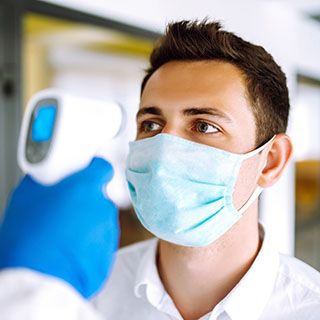
Temperature screening
Over the last 12 months, we have become increasingly familiar with the concept of temperature screening. Airports have already introduced the practice before boarding a flight. As the world opens up, having our temperature taken could become the new norm in a variety of settings, such as large sports events, concerts and at the start of the working day.
However there is some criticism of its efficacy. Data from previous outbreaks of SARS and Ebola, show that the number of cases detected via temperature screening is minimal or non-existent. So when we consider that a large percentage of people with Covid-19 show no symptoms at all, we have to wonder, is it worth it?
Contact tracing
There is no doubt that a robust system of digital contact tracing is an efficient way to minimize the spread of the virus. This was illustrated in countries such as Japan and Taiwan, where fast and effective contact tracing at the start of the pandemic, stopped the virus from circulating out of control.
But, and it’s a big but, contact tracing will only work if everyone is on board. Its success relies heavily on people sharing their contacts and most importantly self-isolating if they test positive.
Autonomous disinfection
Autonomous navigation robots are equipped with UV lights and high-speed atomizers. This allows them to disinfect a closed space efficiently and safely, as harsh chemicals and UV lights are kept away from humans.
But this type of tech comes at a significant cost that is just not viable for many small businesses.
Air purification is the answer
We now know that the main method of transmission for Covid-19 is airborne. Tiny particles of the virus escape into the surrounding air when an infected person coughs, sneezes or talks. These aerosols are so small, they can hang around in the environment for many hours, long after the infected person has left the room.
Effective air filtration, such as the Austin Air HealthMate Plus, is a low-cost, effective way to minimize the number of viral particles* in your workspace.
Using a combination of Medical Grade Certified HEPA Material and carbon, the Austin Air HealthMate Plus removes viruses and other contaminants from the air, keeping you and your staff safe and healthy.
If you’d like more info on the Austin Air HealthMate Plus, why not visit our SHOP page today.
*Covid-19 is a new strain of virus that as yet, remains untested. However, the Medical Grade Certified HEPA Material technology used in our filters is proven to remove up to 99% of all airborne contaminants as small as 0.1 microns.


Share:
Would your home survive a wildfire?
Australian study finds HVAC systems are not enough when it comes to Covid-19