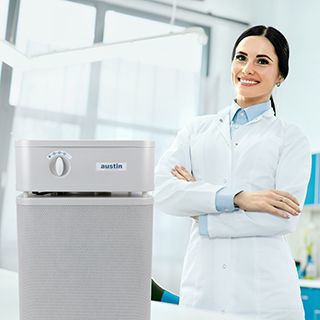
When it comes to selecting the right air purifier, the choices can be confusing. There are numerous technologies available, all claiming to either remove or destroy pollutants. But a review carried out by the EPA sets out to explain why many, so called air purifiers, should be avoided at all costs.
The dangers of Ionizers
Electronic air cleaners, including ESP’s and ionizers, remove particles by creating negative ions. Particles are charged with electricity, they then attach themselves to pollution particles and fall to the ground. However, this technology is problematic on a number of levels.
- The process of creating negative ions can result in the production of ozone, a pollutant that is extremely damaging to our health.
- Deposited particles may be resuspended in the air when disturbed, for example when a person walks into a room or vacuums.
- The number of particles entering the respiratory tract increase if the particles are electrically charged, therefore increasing pollution exposure in the lungs.
- Ionizers do not remove gases or odors
- Even low levels of ozone can react with other chemicals in the environment to produce harmful byproducts.
UV lights don’t belong in an air purifier
UV lights are used in a variety of settings, including hospitals. Instruments are left in a cabinet overnight with a UV light switched on. But using this technology in an air purifier, with air passing through at speed, is not the same thing as leaving instruments exposed overnight. And like ionizers, UV lighting can produce large amounts of ozone.
PCO technology produces harmful byproducts
Air purifiers that use PCO or Photocatalytic Oxidation, use UV lights to transform pollutants into carbon dioxide and water. However this type of technology is extremely controversial. According to the EPA review,
“PCO air cleaners are often completely ineffective in completely transforming gaseous pollutants…”
And it doesn’t stop there, the report goes on to say that PCO air cleaners are….
“..known to generate harmful byproducts such as formaldehyde, acetaldehyde, nitrogen dioxide, and carbon monoxide” and “PCO air cleaners can also generate ozone”
Certified HEPA Material and carbon technology is safe and effective
The review also discusses the pros and cons of using Certified HEPA Material and carbon technology. There is no doubt, this type of technology has been thoroughly tested to ensure it is not only effective but also extremely safe. Using a combination of Certified HEPA Material and carbon ensures the effective removal of pollutants, without the risk of creating other dangerous byproducts.
However, the report is quick to point out that unless a significant amount of Certified HEPA Material and carbon is used, filters will need replacing regularly. Which is why we use an unrivalled amount of carbon (up to 15lbs) and Certified HEPA Material (60 sq ft), in our filters. This ensures a long filter life of up to 5 years and no expensive filter changes.
After reviewing all available technologies, the EPA is clear…
‘Certified HEPA Material (rated) and activated carbon sorbent media filters have generally shown to be the most effective’
#AustinAir #HEPAfilter #ClinicallyProven


Share:
Study finds air pollution linked to 6 million premature births worldwide
Dangers Lurking in Your Baby’s Bedroom