

Every spring, the same narrative returns: pollen is the problem. And while pollen is a major trigger for seasonal allergies, focusing only on it misses a larger picture. For many people — especially those with allergies, asthma, or chemical sensitivities — symptoms don't ease up when they step indoors. That's because what you're breathing inside your home may be just as problematic as what's outside.
The Overlooked Factor: Indoor Air Pollution
Many people assume that staying indoors offers protection from seasonal allergens. In reality, indoor environments frequently contain higher concentrations of pollutants than outdoor air. According to the U.S. Environmental Protection Agency, indoor pollutant levels are generally two to five times higher than outdoor levels. In homes with specific high-emission sources such as new cabinetry, heavy pesticide use, or inadequate ventilation, concentrations can reach significantly higher.1
What makes indoor air particularly complex is that it contains both particles and gases. Particles include dust, pollen, pet dander, and mold spores — substances most people associate with allergies. Gases are less visible but equally impactful.
These include volatile organic compounds (VOCs), which off-gas continuously from everyday household products: cleaning agents, candles, synthetic fragrances, furniture, flooring, cabinetry, adhesives, and freshly painted walls. VOCs don't simply dissipate after use. They linger, accumulate, and interact with other compounds in the air — often in ways that make things worse.

When Chemicals and Allergens Interact
The effect of combined exposures is not simply additive; in many cases, these exposures amplify each other.
Research into traffic-related air pollution and pollen has demonstrated this clearly. Studies have shown that diesel exhaust particles can physically bind to pollen proteins, alter their structure, and in some cases generate new allergenic proteins that weren't present in the original grain — effectively converting a low-allergenicity pollen into one capable of triggering immune responses.2
The second part of the interaction is equally significant. A 2024 review in Physiological Reports found that exposure to nitrogen dioxide (NO2) — a common traffic-related pollutant that also accumulates indoors from gas stoves and combustion sources — increases the permeability and reactivity of airway tissue to allergens, with evidence of heightened sensitization to common allergens in individuals with pre-existing asthma.3
Put more simply: pollutant exposure weakens the airway's barrier function, allowing allergens to penetrate more deeply and trigger stronger responses than they otherwise would. This helps explain why allergy symptoms often feel worse in urban environments, and why indoor chemical exposure can make pollen season significantly harder to weather.

Why Cleaning Can Make You Feel Worse
It seems counterintuitive that cleaning could worsen symptoms. Yet many people notice exactly that.
When surfaces are disturbed, settled particles — dust, pollen, mold spores — are lifted back into the air where they are easily inhaled.
At the same time, conventional cleaning products introduce additional chemicals. Some of the most common — and least discussed — include:
-
Glycol ethers (found in multi-surface sprays) — documented respiratory irritants
-
Quaternary ammonium compounds, or "quats" (found in disinfectants) — linked to airway inflammation and occupational asthma
-
Limonene (found in citrus-scented products) — reacts with indoor ozone to generate formaldehyde and ultrafine particles
The fragrances added to the vast majority of household cleaners also deserve special mention: while they create the perception of cleanliness, they don't remove pollutants — they add to them. For sensitive individuals this can trigger immediate reactions; for others, the effects are subtler but still cumulative.
Marilee Nelson, Board Certified Nutritionist, Certified Bau-Biologist, and co-founder of Branch Basics, emphasizes that even products labeled "non-toxic" or "organic" frequently contain harmful ingredients, including carcinogens, endocrine disruptors, asthmagens, and neurotoxins.
She has developed practical methods to identify and remove these products from the home, which she teaches in her free online course, Toss the Toxins, and the Austin Air Mold Solutions Summit, available free online.
Mold: The Invisible Multiplier
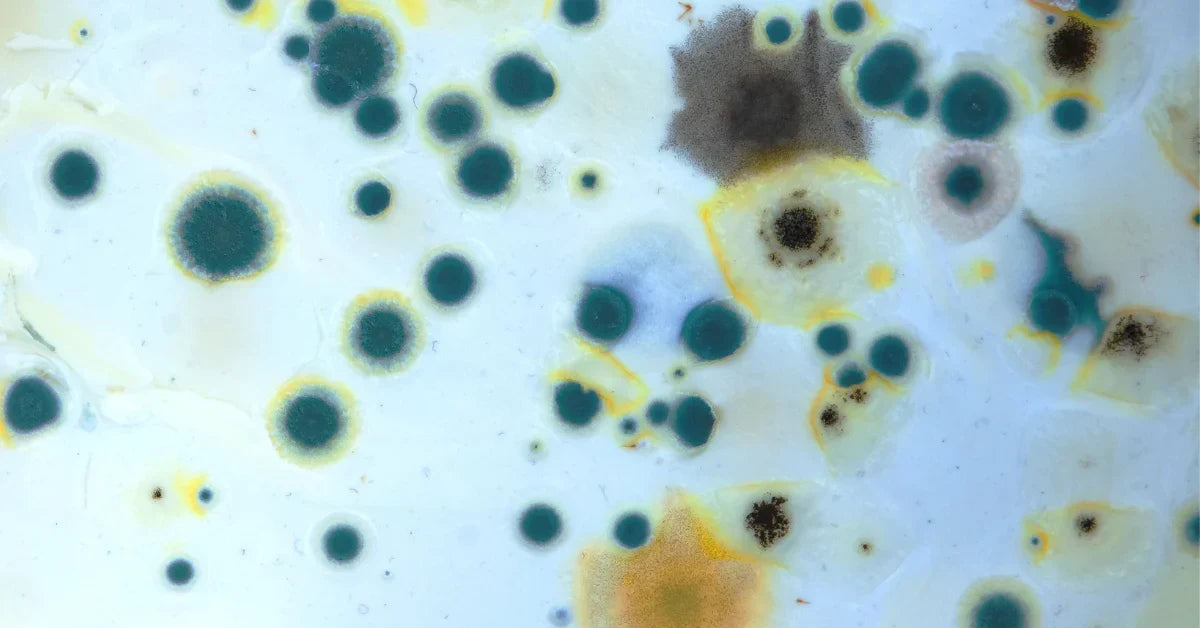
Spring conditions — rising temperatures, increased rainfall, and indoor humidity — create an ideal environment for mold growth, particularly in basements, bathrooms, and kitchens. Mold spores are microscopic and can circulate throughout a home invisibly. Symptoms like respiratory irritation, fatigue, brain fog, and sinus congestion often appear before anyone realizes mold is present, and are frequently mistaken for seasonal allergies.
Beyond spores, mold produces mycotoxins — toxic secondary metabolites — and releases its own VOCs during active growth. In homes where mold coexists with other emission sources like pressed wood furniture, new flooring, and adhesives, the cumulative chemical load can become significant.
Critically, mycotoxin exposure has been shown to heighten sensitivity to other environmental irritants, meaning mold doesn't just add to the total burden — it can amplify reactions to everything else.
John C. Banta, a retired Certified Industrial Hygienist and Indoor Environmental Professional from RestCon Environmental, spoke at Austin Air's Mold Solutions Summit about safe, non-toxic mold remediation. Drawing on over 35 years of experience, he makes the case that harsh chemical cleaners are not necessary — and in many cases counterproductive — for people with CIRS, mold illness, allergies, or environmental sensitivities.

Why It All Adds Up: The Body's Total Load
By now, a pattern should be emerging: pollen, VOCs, cleaning products, mold, and combustion pollutants don't act in isolation. They accumulate — and they interact.
In environmental medicine, this is described as "total load," sometimes called total body burden. Rather than reacting to a single trigger, the body responds to the combined weight of all exposures simultaneously. Throughout most of the year, your body manages this load remarkably well.
But during spring, the balance shifts: the immune system is already activated by pollen and mold spores while indoor exposures are simultaneously rising. The result is not just more symptoms, but more intense and persistent ones. This is why two people can be exposed to the same pollen count and feel completely different
When that cumulative burden is sustained over time, the immune system may stop returning to baseline between exposures. A 2018 study in Environmental Health tracked hospital workers who moved into a higher-VOC building and found measurable increases in airway inflammation markers within just one week.4
A 2021 systematic review in Environmental Research found strong evidence that indoor VOCs — particularly aromatic and aliphatic compounds — were associated with increased asthma symptoms, and importantly concluded that no single exposure appears solely responsible: it is the cumulative effect of everyday products that drives outcomes.5
For people with allergies, this matters enormously. When the immune system is already primed by pollen, it becomes more reactive to everything else — VOCs, mold, fragrances, combustion byproducts. The threshold for a reaction drops. Symptoms that might have been mild in February can feel unmanageable in May, not because the allergens are necessarily worse, but because the body's capacity to cope has been quietly eroded by months of indoor exposure.
This is also the central message of Austin Air's Invisible Enemies webinar series, featuring Dr. Anne Marie Fine and Dr. Lyn Patrick from Environmental Medicine Education International — that health outcomes are rarely the result of a single exposure, but of multiple environmental factors interacting over time.
Reducing the Burden: Where to Start
Because the problem is cumulative, the solution isn't finding one trigger to eliminate — it's systematically reducing the overall load. Small, intentional changes can make a meaningful difference:
-
Choose fragrance-free or low-VOC cleaning products, and be especially cautious with disinfectant sprays containing quats
-
Eliminate synthetic air fresheners and limit candle use, particularly paraffin-based candles
-
Be mindful of off-gassing materials when furnishing or renovating — look for low-VOC flooring, paints, and cabinetry
-
Manage indoor humidity (ideally 30–50%) to limit mold growth
-
Address water damage and potential mold sources promptly, before spring humidity peaks
Even with these steps, it's nearly impossible to control every source of airborne exposure — and for those already living with allergies, asthma, or COPD, "nearly impossible" isn't good enough. Allergens, mold spores, mycotoxins, and chemical pollutants all travel through air — improving what you breathe can reduce many exposures at once, often more efficiently than addressing each source individually.
Austin Air's Asthma, Allergies, andd COPD Bundle was designed with exactly this in mind: whole-home coverage for people whose airways are already sensitized, combining medical-grade HEPA filtration with activated carbon adsorption to address both the particles and the gases that standard filters miss. Flexible payment plans are available, and Austin Air proudly accepts Flexible Spending Account (FSA) and Health Savings Account (HSA) account funds. Call us at 716-856-3700 or 1-800-724-8403 to learn more.
In a world where full avoidance isn’t realistic, the goal is to create an environment that supports your body. And that starts with the air.
Final Thought: When the Load Is Too Much
For many people, spring allergies have changed. Symptoms feel stronger, last longer, and are harder to predict. This isn't simply a reflection of rising pollen counts — it reflects the total burden the body is carrying, including the ongoing chemical and biological exposures that accumulate indoors year-round.
When that load is reduced — even modestly — the body often responds quickly. Clarity, comfort, and resilience can return faster than most people expect. Because in the end, it's not just about what you're reacting to. It's about how much your body is being asked to handle at once — and how much of that you can remove.

REFERENCES
1 Reference guide for indoor air quality in schools. (2025 November 13). US Environmental Protection Agency. https://www.epa.gov/iaq-schools/reference-guide-indoor-air-quality-schools.
2 Chehregani A, Kouhkan F. (2007 June 26). Diesel exhaust particles and allergenicity of pollen grains of Lilium martagon. Ecotoxicology and Environmental Safety. 69(3):568-73. https://doi.org/10.1016/j.ecoenv.2007.05.007.
3 Wallbanks S, Griffiths B, Thomas M, Price OJ, & Sylvester KP. (2024 August 22). Impact of environmental air pollution on respiratory health and function. Physiological Reports, 12, e70006. https://doi.org/10.14814/phy2.70006.
4 Kwon, JW, Park, HW, Kim, WJ. et al. (2018 August 7). Exposure to volatile organic compounds and airway inflammation. Environmental Health. 17, 65. https://doi.org/10.1186/s12940-018-0410-1.
5 Paterson CA, Sharpe RA, Taylor T, Morrissey K. (November 2021). Indoor PM2.5, VOCs and asthma outcomes: A systematic review in adults and their home environments. Environmental Research. 202, 111631. https://doi.org/10.1016/j.envres.2021.111631.


Share:
Pet Allergies Don't Have to Mean Giving Up Your Pet—Here's What Actually Helps
Is Spring Cleaning Making You Sick?