
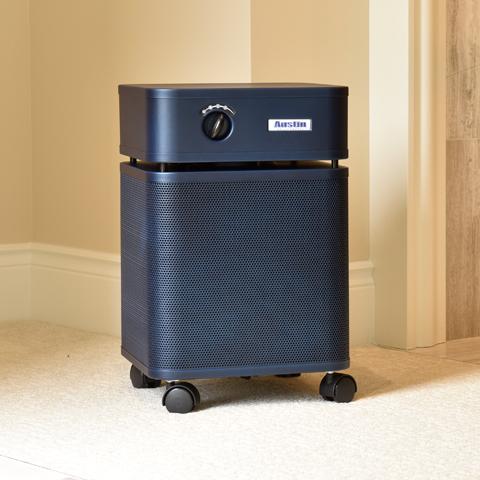
Our involvement in clinical trials started in 2001 when we were selected by the American Academy of Pediatrics and the country’s number one children’s hospital, Cincinnati Children’s Hospital, to take part in a clinical trial.
Our work with the American Academy of Pediatrics
The aim of the study was to measure how an Austin Air Purifier could help to reduce children’s asthma symptoms and minimize visits to the ER. The air purifiers were run in the bedroom at night and in the main family room during the day. Over a twelve-month period, the children’s asthma improved and the number of visits to the emergency room was reduced dramatically.
The Austin Air – Johns Hopkins Clinical Trials
The success of this trial paved the way for others. In 2009 we were approached by the renowned Johns Hopkins University Hospital in Baltimore. This time to measure how effectively our air purifiers could reduce levels of indoor Nitrogen Dioxide. Nitrogen Dioxide (NO2) is a gas often present in homes where there are gas stoves. It is particularly dangerous for people with COPD, as it can cause coughing, wheezing and chest tightness. Again participants were given two Austin Air Purifiers, to be used in the kitchen and the bedroom. Again, results were impressive, NO2 levels dropped and air quality improved significantly.
Shortly after, we teamed up with Johns Hopkins University Hospital for a second time. This study was designed to measure how using an Austin Air Purifier could improve indoor air quality for pregnant women or women with very young children, living with a smoker. Again two Austin Air Purifiers were installed in each home. And once again it was clinically proven that our air purifiers are extremely effective at removing PM2.5 and what’s more, 98% of the women said they would recommend an Austin Air Purifier to friends and family looking to improve indoor air quality.
We went on to conduct a number of studies with Johns Hopkins and are still working with the university at the time of writing.
The University of Washington Trial
In 2015, we partnered with the University of Washington, to measure how using an Austin Air Purifier could help to improve air quality for children with asthma, living in the Yakima Valley, Washington State. The area is known for a range of intensive agricultural activities, that have a major impact on pollution levels.
For the purposes of the study, an Austin Air Purifier was placed in both the living area and the child’s bedroom, pollution levels were then closely monitored. As with previous studies, the results were significant. Pollution levels in the living area were reduced by 48% and in the children’s bedrooms, they were reduced by an incredible 65%.
Our work with Franklin W. Olin College of Engineering in Boston
In 2019 we joined forces with Franklin W. Olin College of Engineering in Boston, to improve air quality for residents living near to the airport in East Boston. This time the team investigated how using an Austin Air HealthMate could help to improve indoor air quality and subsequently lower a person’s blood pressure.
77 people, with no underlying health concerns took part in the trial. The participants were split into 2 groups. Over a number of weeks both groups were exposed to varying levels of pollution indoors. One group spent time in a room with an Austin Air HealthMate™ running, and one group spent time in a room with no air filtration.
The research team kept a close eye on air quality levels and the participants blood pressure, for the duration of the study. On both counts they noticed a real difference when using our units. Blood pressure remained low and there was a 10-fold decrease in pollution levels in the rooms where an Austin was running.
Five clinical trials, five successful outcomes
Five published clinical trials, five successful outcomes. And although the results of the trials confirm what we have known for many years, this has been a real game changer for us. We have achieved something no other air purifier has. Independently tested, by some of the country’s leading hospitals, we were (and still are) the only air purifier to be clinically proven in this way.


Share:
Scientific air quality study moves to next phase!
Smoke from wildfires used to study effects of nuclear war