
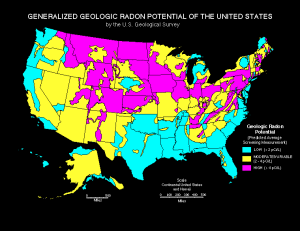
It’s invisible. It’s odorless. It’s tasteless. It’s the number one cause of lung cancer for non-smokers in America. It may be in your home, and you wouldn’t even know it. It’s radon – a radioactive gas that is thought to contribute to tens of thousands of deaths each year and it’s relatively common. The good news is that if unsafe levels of radon are detected in your home, you can fix the problem. For this reason January is National Radon Action Month, to encourage people to test for radon. So make sure to take action and protect yourself and your loved ones from potential harmful radon exposure.
This is the story of Eddie, a non-smoker and survivor of lung cancer, who found extremely elevated radon levels in his home after being, diagnosed… https://www.youtube.com/watch?v=WcvoZ1pP3ak
What exactly is radon? Radon is a chemical element that originates from the breakdown of radioactive (yet naturally occurring) elements: uranium, thorium, and radium. When uranium and thorium deposits breakdown within the soil, rock, or water, under a home or building; radon can enter the air and get trapped inside, reaching harmful levels if not treated. Radon travels easily through small openings into any building. It can enter through cracks in the foundation, construction joints, gaps between floors and around service pipes, and it can even seep in through the water supply. Don’t be fooled, it can be found in both drafty homes and well-sealed homes. It may also be found in homes with or without basements. Radon poses no threat in small diluted amounts, but we should take caution with elevated amounts of radon. The Environmental Protection Agency (EPA) estimates that 1 out of every 15 homes in the United States has elevated radon levels so it’s a commonly occurring issue.
The ill effects of radon are not caused by the gas itself, but from the byproducts of its decay after entering the body. The tiny particles left over are small enough to be inhaled into our lungs and lodge themselves in the body as they continue to decay, releasing radioactive isotopes into the lungs. This is the reason for the high occurrences of lung cancer due to radon exposure, as much as 20,000 deaths annually. Smokers are more vulnerable to the effects of radon than non-smokers, making it especially important for them to get their homes checked.
The EPA released the above map of high-risk radon zones, which is often located in areas primarily made up of granite. Since radon is naturally stored under layers of rock, it appears as if the high readings of radon are in the areas where glacial activity flourished during the Pleistocene era, from around 110,000 to 12,000 years ago, clearing the top layers of rock and exposing the decaying radioactive materials.
Testing your home for radon doesn’t take much effort but in order to get an accurate reading, testing should be completed several times over a year-long time frame to get a good understanding of your total radon exposure throughout different seasons and variables. If the testing sample does not span a long enough time frame, you risk an inaccurate reading, as you may be experiencing varied rates of radon exposure over time. It is recommended to check your air quality during the winter months, as this is when your windows are typically closed most of the time – hindering airflow and the dilution of harmful particles. However, if you’re looking for short-term results, there are tests designed to last anywhere from two days to 90 days, which can help you determine if immediate action is needed. Test kits can be purchased over the internet, or in most big-box and home improvement stores. The short-term kits can be purchased for anywhere from $12 – $20, where the long-term kits can be from upwards of $30.
Once radon is detected in your home, the specific repairs needed to be made will vary depending upon your home’s specific conditions and the indoor air circulation and quality. Most importantly, if you do have elevated levels of radon leaking into the home, you’ll want to ensure that your home is well-ventilated to prevent a build-up of the harmful chemical. This may entail looking for ‘dead zones’, where air in the room does not flow, like wall-ceiling intersections or in the corners of a room. If these ‘dead zones’ are too wide-spread within the home, radon may accumulate. Dead zones are also important to look for when thinking about medical grade air purifiers and HVAC systems as well, as the size of the room and the efficiency of the airflow will affect the efficacy of your air purifiers and other air systems.

Ideally, you’ll be able to eliminate radon from even entering your home in the first place. This consists of sealing all cracks and potential places where radon can enter a building, including in the spaces surrounding where pipes enter and exit the home. If there are places where there is an earth floor, as in a crawl space or a dirt floor basement in an older home, you may wish to consider sealing the bottom of the house with a non-permeable vapor barrier, and/or by depressurizing the area beneath the slab of concrete. Depressurizing beneath the slab includes the installation of a piping system connected with a fan, which is run above the eaves of the roof to discharge the affected air. This is often used in conjunction with the vapor barrier, especially for homes with elevated radon levels. There are various sizes of fans, and while this can be done as a do-it-yourself project, an expert in indoor air quality and radon mitigation should be consulted.
The EPA has put together a state-by-state guide for resources regarding radon detection and mitigation in your area, to help solve the problem of radon and the associated cancer risks. In this state-by-state guide, you’ll find access to test kits and experts in the field, as well as a listing of state building codes, and other resources. We’ve shown you the reasons you should care about radon in your home, so the next step is in your hands, and now is the time to act! Hopefully we’ve opened your eyes to testing for radon and why you need to look out for this silent menace. It is our hope that the resources mentioned in this article will help you keep your home safe from any potential harm.


Share:
Finding Your Perfect Exercise Program
Indoor Air Quality Explained