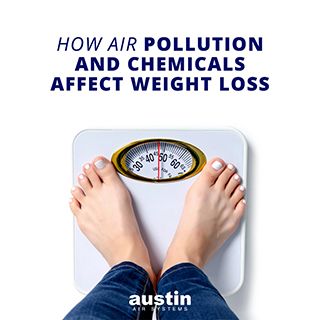
The holidays are magical. A few short weeks of hitting the cookie tray and — poof! — your waist size magically goes from a size 8 to a size 12! A few dinners and drinks with friends and — voila! — you’ve got the same puffy cheeks and hands you had as a baby.
Then comes January. The magic wears off. You hit the gym instead of the cookie tray and – poof! – nothing happens. The pounds don’t budge. You skip dinner and drinks with friends and – voila! – you’re still puffy.
That’s because sometimes there’s more to maintaining a healthy weight than just calories and exercise. Recent data suggests that poor air quality has a “sizable” impact on weight, too.
In fact, researchers have found that inhaling pollutants, such as automobile and diesel exhaust, can disrupt signaling between fat cells causing them to grow 12 to 25 percent larger in size or even increase in number. (1)
Animal studies confirm this. In a 10-week study, mice who inhaled a fine mist of pollutants had fat cells that were approximately 20 percent larger in size. These mice also showed greater volumes of visceral fat – body fat around the abdomen and internal organs. (2)
Why does this happen? The research seems to point at three causes: inflammation, hormone disruption, and metabolism.
Air Pollutants Cause Inflammation in the Body and the Brain
On-going exposure to airborne contaminants triggers a widespread release of inflammatory molecules called ‘cytokines,’ which can increase fat storage, especially around the abdomen. Fat storage around the abdomen creates a vicious cycle because it is metabolically active. It actually creates additional inflammatory cytokines.
To make matters worse, these cytokines can also increase inflammation in the area of the brain that regulates appetite and interacts with hunger hormones. This can result in a condition known as leptin resistance. Leptin is the hunger hormone that tells the brain you’re full, so you stop eating. Inflammation makes the brain resistant to leptin’s signals, which leads to overeating because you never feel full.
Household Chemicals Disrupt Key Hormones
There are chemicals, called obesogens, used in consumer products that disrupt the communication of specific hormones that tell the body how to make, store, and use fat. These chemicals are found in things such as electrical equipment, caulking, paints, electronics, furniture, textiles, vinyl, plastics, fragrances, lotions, detergents, and pesticides – to name just a few. (3)
Many of these chemicals are called volatile organic compounds, or VOCs. They are especially difficult to detect and eliminate because they are emitted as gases such as propane, butane, ethanol, phthalates, and formaldehyde.
These VOCs and obesogens can inhibit fat cells from releasing stored fat, making it difficult for the body to “burn” fat – no matter how little you eat or how much you exercise.
This can even be passed down from mother to child as studies show pregnant mice exposed to certain chemicals produce offspring with greater fat deposits, and this phenotype was found to be passed on to the third generation. (4)
What’s more, research shows a link between air pollution and childhood obesity, too. Children who were exposed to indoor air pollutants like nitrogen dioxide and heavy metals had a higher incidence of obesity. (5)
Airborne Toxins Impair Glucose Metabolism
Exposure to air pollutants has also been associated with poor glucose metabolism, particularly an increase in the levels of fasting blood glucose and hemoglobin A1c. (6)
Consistently high blood sugar can cause insulin resistance, similar to leptin resistance, where cells quit responding properly to insulin. This leads to elevated sugar and insulin levels, which is a major cause of weight gain.
Reduce Airborne Contaminants and Lose Weight
While diet and exercise are vital components of a healthy weight loss program, air purification could be equally important for some.
The Austin Air HealthMate Plus™ uses 60 sq. ft. of True Medical Grade Certified HEPA Material and more than 780 cubic inches of Activated Carbon, to remove the most common airborne contaminants (including VOCs) contributing to inflammation, hormone disruption, impaired glucose metabolism, and weight gain.
The 360-degree intake system draws air into all sides of the HealthMate Plus™ passing it through a 4-stage filter, and then – poof! – up to 99% of all airborne contaminants* are gone! Out comes “thin air.”
You might even call it magical.
* Medical Grade Certified HEPA Material effectively removes 99% of airborne viruses that are 0.1 microns and larger.
Resources:
- https://www.dmagazine.com/frontburner/2019/11/a-new-study-finds-air-pollution-can-make-you-fat/
- https://www.bbc.com/future/article/20151207-the-air-that-makes-you-fat
- https://www.ncbi.nlm.nih.gov/pmc/articles/PMC2677823/#:~:text=These%20include%20PCBs%2C%20used%20in,built%20environment%3B%20phthalates%2C%20used%20in
- https://www.ncbi.nlm.nih.gov/pmc/articles/PMC5359373/
- Early-Life Environmental Exposures and Childhood Obesity: An Exposome-Wide Approach | Environmental Health Perspectives | Vol. 128, No. 6 (nih.gov)
- https://ehjournal.biomedcentral.com/articles/10.1186/s12940-020-00623-9


Share:
HEGA Carbon Cloth Helps Protect Against Covid-19
Governor Kathy Hochul Announces New Billion-Dollar Rescue Plan for Small Businesses in New York State