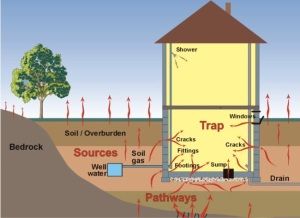
Radon is a gas that occurs naturally as uranium and thorium break down in soil, rocks and water. Outdoors, Radon levels generally remain low, as it dissipates into the air. Nothing too sinister about that you might think. However, Radon is radioactive, and it can find its way into your home, seeping up from the soil, through the cracks and holes in your house foundations. According to the CDC, after smoking, Radon is the leading cause of lung cancer. And as many as 1 in 15 homes in the US have high Radon levels. OK, perhaps not so harmless after all.

Radon is colorless, odorless and tasteless and symptoms of exposure may occur years later, making it almost impossible to detect without carrying out a specific test. Testing for Radon in the home can be run over the short and long term but Radon levels can fluctuate, so short term tests are fairly limited. Testing over a longer period of time will give a more accurate result. The test itself is relatively straightforward. A device is placed in the home, with doors and windows closed and a reading taken.

If low levels of Radon are detected, it may simply be a case of sealing up cracks and holes and improving ventilation in the home, so that the gas can escape. If Radon levels still remain high, a more comprehensive mitigation system may be needed. But even this is relatively simple and inexpensive to install.

If you’re worried about Radon levels in your home, follow this link for more advice.

Leave a comment

Please note, comments need to be approved before they are published.

This site is protected by hCaptcha and the hCaptcha Privacy Policy and Terms of Service apply.

Latest Stories

View all

Your Back-to-School Respiratory Reset: Get Ahead of Cold and Flu Season

Your Back-to-School Respiratory Reset: Get Ahead of Cold and Flu Season

School season is on its way in full swing; You have a head start, so use it. Cold and flu season in North America usually builds through the fall and peaks between December and February—which makes late summer the ideal time to build resilience, not scramble for it.¹ Your defenses aren't fixed. Sleep, food, movement, and the air you breathe measurably change how easily you catch—and shake off—respiratory bugs. There are five factors you can control starting today: Detox your home's air, protect sleep, feed the immune system, move every day, and switch to safer cleaners. It's simple and family-friendly. No doctor's appointment or big budget required. Most of it you can do with your kids this week. Cleaner indoor air ties it together. It's the backdrop to everything else—and where the free Parent-Teacher Toolkit and the 8-phase Immunity Machine come in.


Read moreabout Your Back-to-School Respiratory Reset: Get Ahead of Cold and Flu Season

New CDC Mold Data (2026): What It Really Means

New CDC Mold Data (2026): What It Really Means

The first CDC study to measure invasive mold disease—who’s actually at risk, and what it means for the air in your home. In late July 2026, the CDC published the first systematic estimate of how often invasive mold disease occurs in American hospitals. Researchers reviewed 968 possible cases at four Atlanta-area hospitals between 2020 and 2024 and confirmed nearly 450 of them as invasive mold disease. This disease is a serious infection in which mold moves from the airways into the lungs, sinuses, skin, or bloodstream, . ¹

Read moreabout New CDC Mold Data (2026): What It Really Means

The Travesty No One Is Reporting: Schools Are Throwing Away the Air Purifiers Our Kids Still Need

The Travesty No One Is Reporting: Schools Are Throwing Away the Air Purifiers Our Kids Still Need

Five or six years ago, putting air purifiers in classrooms was front-page news. Today those same machines are being sold on eBay, stacked in storage sheds, and left at the curb for the garbage truck—while asthmatic children sit in the very rooms they were bought to protect. Here is why every parent and teacher should be paying attention.

Read moreabout The Travesty No One Is Reporting: Schools Are Throwing Away the Air Purifiers Our Kids Still Need