
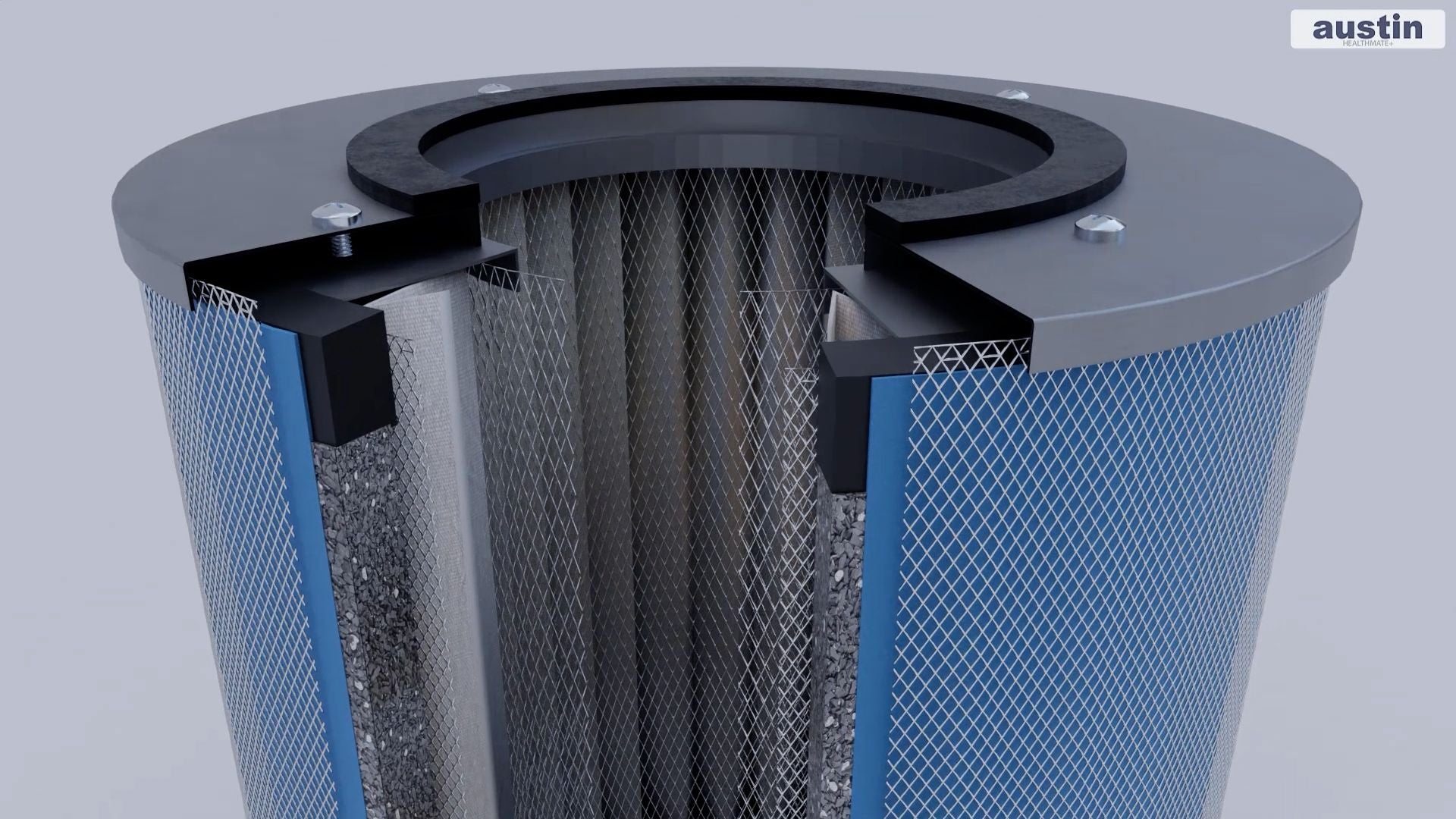
A review by the EPA looked at the most common types of air filters and found that using a combination of Certified HEPA Material and activated carbon (like the Austin Air filters) is the most effective.
What’s even better, Austin Air uses more Certified HEPA Material and activated carbon than anyone else in the industry! We use 60 square feet of true medical-grade Certified HEPA Material and up to 15 lbs. of activated carbon and zeolite.
Read more about what the EPA review said about Certified HEPA Material and activated carbon below.
What are Certified HEPA Material filters?
Certified HEPA Material is an acronym for “high-efficiency particulate air” filter. Certified HEPA Material filters are a type of pleated filter. (Think accordion!) These filters have very deep pleats with a much larger surface area than conventional pleated filters. Consequently, they remove fine and ultrafine particles with higher efficiency than lower-rated fibrous media air filters.
Figure 4 from the EPA review shows an example of several commercially available residential fibrous media air filter products for central in-duct applications ranging from 1-inch fiberglass MERV 4 filters to 5-inch deep pleated MERV 16 filters.
Fewer studies have investigated the impact of portable air cleaners on gaseous pollutant concentrations or portable air cleaner use patterns over time. One study demonstrated that the use of a portable Certified HEPA Material air cleaner with an activated carbon media filter also reduced indoor nitrogen dioxide concentrations in residences immediately after follow-up, although the reductions diminished over time, likely as occupants began to operate the air cleaners less often (Paulin et al. 2014). (Page 42)
ACTIVATED CARBON
Activated carbon is considered a gas-phase air-cleaning technology. (Page 29) In other words, gases in the air are adsorbed (or they get “caught”) in the pores of the carbon. The air that passes through the filter is then purified of these adsorbed gases.
Activated carbon is the most common adsorbent used in HVAC systems and portable air cleaners to remove gaseous contaminants. It has the potential to remove most hydrocarbons, many aldehydes, organic acids through adsorption, and ozone through chemisorption. However, activated carbon is not especially effective against oxides of sulfur, hydrogen sulfide, low molecular weight aldehydes (e.g., formaldehyde), ammonia, and nitrogen oxide. (Page 29)
Therefore, the thicker the media, the more efficient the filter will be for longer periods of time. (Page 29)
Several studies have estimated that potential health benefits of using particle filtration to lower indoor exposures to PM of outdoor origin, including wildfire emissions, are large, and the estimated financial benefits far exceed the estimated costs (Fisk and Chan 2017a, b; Montgomery et al. 2015; Zhao et al. 2015).
Another recent modeling study came to similar conclusions for using activated carbon filters in homes to reduce indoor ozone of outdoor origin (Aldred et al. 2015).


Share:
A Review by the EPA Warns Against PCO and Plasma Air Purifiers
How to Detox from Chemical Exposure Series, Part 1: Stop Further Exposure